
August 2020, page 20
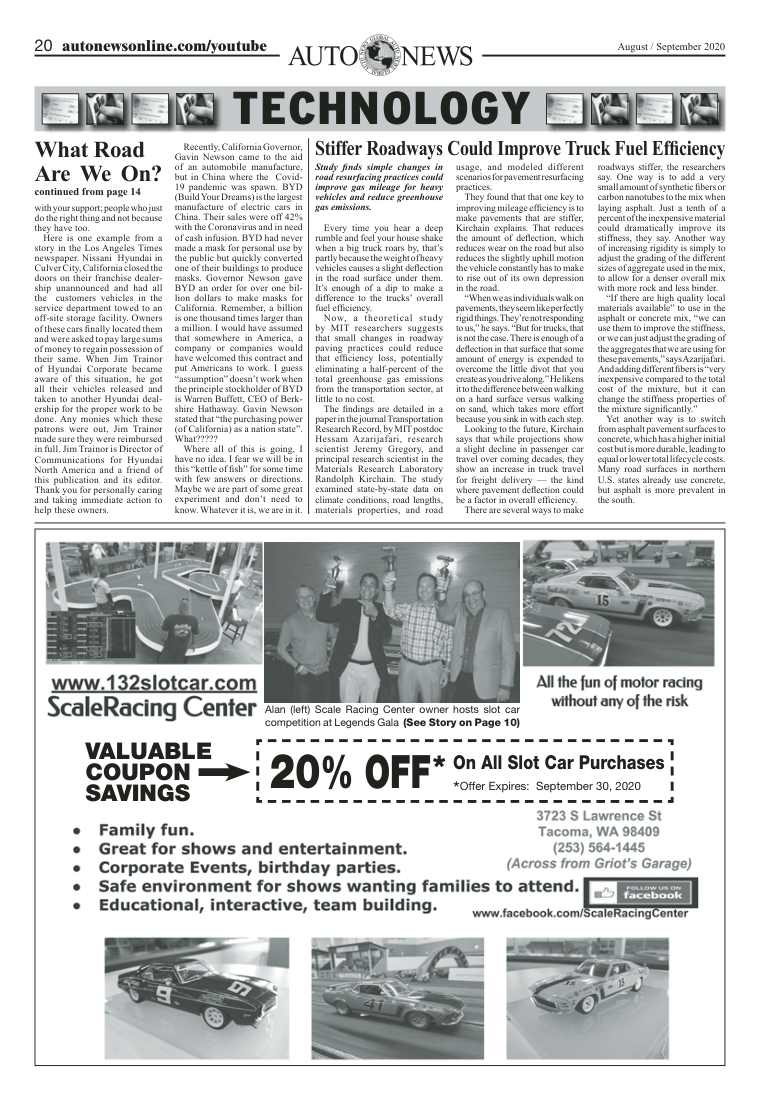
Text of this page
TECHNOLOGY
Recently, California Governor, Gavin Newson came to the aid of an automobile manufacture, but in China where the Covid- 19 pandemic was spawn. BYD (Build Your Dreams) is the largest manufacture of electric cars in China. Their sales were off 42% with the Coronavirus and in need of cash infusion. BYD had never made a mask for personal use by the public but quickly converted one of their buildings to produce masks. Governor Newson gave BYD an order for over one billion dollars to make masks for California. Remember, a billion is one thousand times larger than a million. I would have assumed that somewhere in America, a company or companies would have welcomed this contract and put Americans to work. I guess “assumption” doesn’t work when the principle stockholder of BYD is Warren Buffett, CEO of Berkshire Hathaway. Gavin Newson stated that “the purchasing power (of California) as a nation state”.
Where all of this is going, I have no idea. I fear we will be in this “kettle of fish” for some time with few answers or directions. Maybe we are part of some great experiment and don’t need to know. Whatever it is, we are in it.
What Road Are We On?
with your support; people who just do the right thing and not because they have too.
Here is one example from a story in the Los Angeles Times newspaper. Nissani Hyundai in Culver City, California closed the doors on their franchise dealership unannounced and had all the customers vehicles in the service department towed to an off-site storage facility. Owners of these cars finally located them and were asked to pay large sums of money to regain possession of their same. When Jim Trainor of Hyundai Corporate became aware of this situation, he got all their vehicles released and taken to another Hyundai dealership for the proper work to be done. Any monies which these patrons were out, Jim Trainor made sure they were reimbursed in full. Jim Trainor is Director of Communications for Hyundai North America and a friend of this publication and its editor. Thank you for personally caring and taking immediate action to help these owners.
Stiffer Roadways Could Improve Truck Fuel Efficiency
Study finds simple changes in road resurfacing practices could improve gas mileage for heavy vehicles and reduce greenhouse gas emissions.
Every time you hear a deep rumble and feel your house shake when a big truck roars by, that’s partly because the weight of heavy vehicles causes a slight deflection in the road surface under them.
It’s enough of a dip to make a difference to the trucks’ overall fuel efficiency.
Now, a theoretical study by MIT researchers suggests that small changes in roadway paving practices could reduce that efficiency loss, potentially eliminating a half-percent of the total greenhouse gas emissions from the transportation sector, at little to no cost.
The findings are detailed in a paper in the journal Transportation Research Record, by MIT postdoc Hessam Azarijafari, research scientist Jeremy Gregory, and principal research scientist in the Materials Research Laboratory Randolph Kirchain. The study examined state-by-state data on climate conditions, road lengths, materials properties, and road usage, and modeled different scenarios for pavement resurfacing practices.
They found that that one key to improving mileage efficiency is to make pavements that are stiffer, Kirchain explains. That reduces the amount of deflection, which reduces wear on the road but also reduces the slightly uphill motion the vehicle constantly has to make to rise out of its own depression in the road.
“When we as individuals walk on pavements, they seem like perfectly rigid things. They’re not responding to us,” he says. “But for trucks, that is not the case. There is enough of a deflection in that surface that some amount of energy is expended to overcome the little divot that you create as you drive along.” He likens it to the difference between walking on a hard surface versus walking on sand, which takes more effort because you sink in with each step.
Looking to the future, Kirchain says that while projections show a slight decline in passenger car travel over coming decades, they show an increase in truck travel for freight delivery — the kind where pavement deflection could be a factor in overall efficiency.
There are several ways to make roadways stiffer, the researchers say. One way is to add a very small amount of synthetic fibers or carbon nanotubes to the mix when laying asphalt. Just a tenth of a percent of the inexpensive material could dramatically improve its stiffness, they say. Another way of increasing rigidity is simply to adjust the grading of the different sizes of aggregate used in the mix, to allow for a denser overall mix with more rock and less binder.
“If there are high quality local materials available” to use in the asphalt or concrete mix, “we can use them to improve the stiffness, or we can just adjust the grading of the aggregates that we are using for these pavements,” says Azarijafari. And adding different fibers is “very inexpensive compared to the total cost of the mixture, but it can change the stiffness properties of the mixture significantly.”
Yet another way is to switch from asphalt pavement surfaces to concrete, which has a higher initial cost but is more durable, leading to equal or lower total lifecycle costs. Many road surfaces in northern U.S. states already use concrete, but asphalt is more prevalent in
What?????
Alan (left) Scale Racing Center owner hosts slot car competition at Legends Gala (See Story on Page 10)
(Across from Griot’s Garage)
3723 S Lawrence St
Tacoma, WA 98409
(253) 564-1445
or (253) 255-1807
continued from page 14
Valuable
Coupon
Savings
20% Off* On All Slot Car Purchases
*Offer Expires: September 30, 2020
the south.